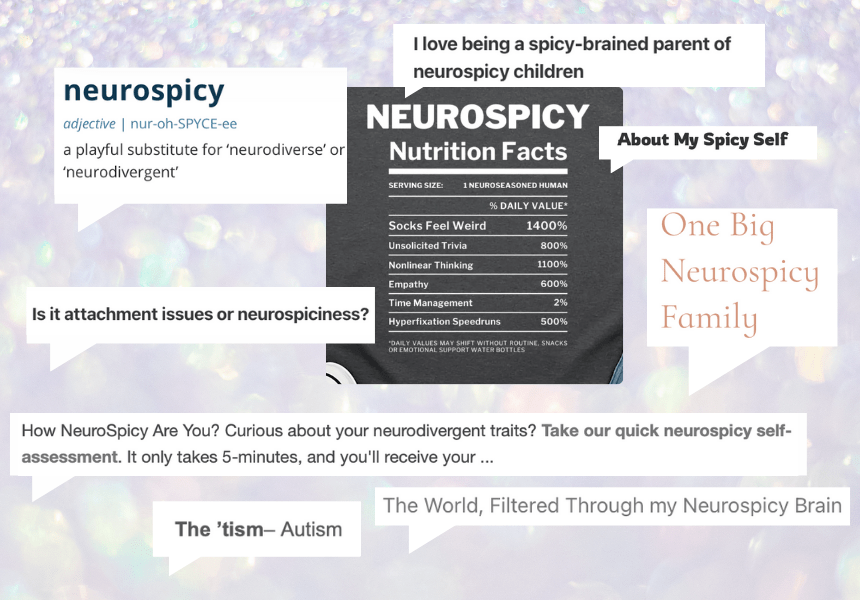
I’m writing to a non-existent Autistic woman named Jessica. I came across her writing piece today describing the experience of being a late-diagnosed Autistic woman. I am always looking for a deeper connection to the label I feel defined by, so, of course, I was elated. Almost immediately, though, I read the catchline: “for my neurospicy girls!”
Gag me.
I know Jessica meant no harm, just like everyone else who uses the term “neurospicy.” She probably thinks she’s raising awareness or lightening the mood, but she’s just making my eyes roll. I don’t enjoy sharing my label with people who use terms like “neurospicy.” I just don’t. It’s not funny to be Autistic, and my brain isn’t “spicy;” I’m disabled.
“Whoa whoa! Why so serious?” You say, “disabled is a strong word.” Well, let’s look at that a little closer.
There are two models to consider when defining a disability. The traditional medical model defines disability as some impairment that prevents someone from fully engaging in society. The social model of disability, in contrast, defines disability as differences that, because of society’s foundational prejudices, prevent someone from fully engaging in traditional daily life. I personally fall somewhere in the middle; disability is something that fundamentally alters the way you interact with the world, but those interactions are further altered by the social structures in place.
Autism is, therefore, a disability for me. It influences how I work, how I study, how I spend my time, how I take care of myself, how I make friends, and how I date. A lot of these adaptations are invisible to others, but that doesn’t make them any less real to me. However, that invisibility makes it harder for people to conceptualize my Autism as a disability. I don’t claim that label on behalf of anybody else who is Autistic, but I do encourage you to think critically about why Autism being a disability, in cases such as mine, is an uncomfortable conclusion. I find that a lot of people like to forget I’m Autistic until it’s convenient for them or their needs. Would you rather I only embrace the “easy” parts of being Autistic? Would you like to have me as an inspiration, as a wallflower, as a mirrorball, as an advocate, and forget the rest of me? No. I have carved space with my bare hands, and I will not apologize for the dirt under my nails.
Now that that’s out of the way, let’s address Jessica’s TikTok-ification of Autism.
It’s weirdly humiliating. Autism has become a new punch line that strikes me square in the chest each time. An acquaintance uses Autistic as an adjective for someone who is “a little weird,” and all my friends turn to me, like they’re waiting to see how they should react, like the weight of Autism representation rests squarely on my shoulders. If I protest, if I try to explain, my words are minuscule in comparison to the number of memes they have seen that contradict me. It’s partly my fault. When someone says something hurtful unintentionally, I try to brush it off and move on. I like to give the benefit of the doubt that they are parroting the things they have heard before. I don’t stand up for myself nearly as often as I should. Instead, I pretend I don’t hear while my heart breaks inside. It’s also partly a broader problem that is a modern continuation of ableism; completely out of my hands and entirely too complex to unravel in less than a dissertation.
Usually, I find the assimilation of online language into daily conversation to be a fascinating result of the fluidity of language and the strength of internet culture. We are amazing, adaptable creatures constantly seeking new ways to identify with each other, and language is a perfect tool to do so. In this case, though, the language being used to describe Autism is actively harmful not only to me but also to the whole community.
There are a couple of reasons I hate these internet terms slung around to describe Autism.
It promotes the stigma surrounding Autism and Autistic experiences by making people uncomfortable using real terms and discussing real elements of Autism.
The more people use words like “neurospicy,” the less people are comfortable with the word Autism itself. The less comfortable people are with the word Autism, the less they’re willing to interact with Autism and, therefore, Autistic people. This cycle leads to disinterest at best, disgust at worst, and so the stigma against Autism grows.
When I hear the word “neurospicy,” the first thing I think of is the overwhelming distress of a meltdown. When I meltdown, I lose control of my ability to speak, I cry uncontrollably, and I hyperventilate. Before I learned how to redirect my emotions, I used to hit myself (and sometimes I still want to) when I got overwhelmed. I have been in therapy since I was 9 years old and medicated since I was 16 years old to address my emotional regulation difficulties. That’s not “spicy,” that’s painful and real. Being afraid to talk about the ugly truths of Autism can only be stigmatizing.
It reduces the reality of my diagnosis, my identity, and my lived experiences to a childish trend.
Oftentimes, when people are using terms like “neurospicy,” they are, purposefully or inadvertently, presenting their audience with a version of Autism that is childish and simplistic. When something becomes trendy, it loses a lot of credibility. Even more so when that trend actively competes with the medical and social realities of a diagnosis. People have begun to treat the diagnosis of Autism as something you can opt into, meaning it should be just as easy, in their eyes, to opt out. People who don’t fit the social mould are seen as making a conscious choice to overstay their welcome and are treated as such.
My experience being Autistic is unique. Many elements of my life shock non-Autistic people who are accustomed to the narrow definition presented on social media. I’m not alone; every Autistic person lives a life that stretches beyond what non-Autistic people think they can be. Stereotypes are claustrophobic, and pushing the boundaries of those stereotypes is exhausting. Instead of devoting energy to improving my quality of life, that same energy now flows into convincing people that I really am Autistic, despite what stereotypes would have you believe. “Neurospicy” is acceptable because stereotypes thrive, and stereotypes are reinforced because we promote them with terms like neurospicy. What a vicious cycle to contribute to.
Look, I’m not the language police. You want to keep making videos and blog posts about “being a neurospicy person?” Fine. Do what you think raises awareness or lightens the mood or whatever. I’m also not saying there isn’t a space for comedy in being Autistic. I have heard some downright hilarious jokes made by and about Autistic people, but the funniest ones never punch down. What is there to laugh about in the fact that your audience is uncomfortable with the word Autistic?
I’m very privileged to be a well-spoken, low-support needs Autistic person. I would be remiss if I didn’t use that privilege to tell you that your constant couching of Autism is only hurting how (not) seriously we are taken by non-Autistic people. The words we choose matter, especially when we have the weight of Autistic people who cannot as easily self-advocate on our shoulders.
For the love of God, just say Autistic Jessica. You’d have no problem doing it as a punchline anyway.
 Simone Brown