Tag: blog

  • You’re not “neurospicy” Jessica, you’re disabled.

    You’re not “neurospicy” Jessica, you’re disabled.

    I’m writing to a non-existent Autistic woman named Jessica. I came across her writing piece today describing the experience of being a late-diagnosed Autistic woman. I am always looking for a deeper connection to the label I feel defined by, so, of course, I was elated. Almost immediately, though, I read the catchline: “for my neurospicy girls!”

    Gag me.

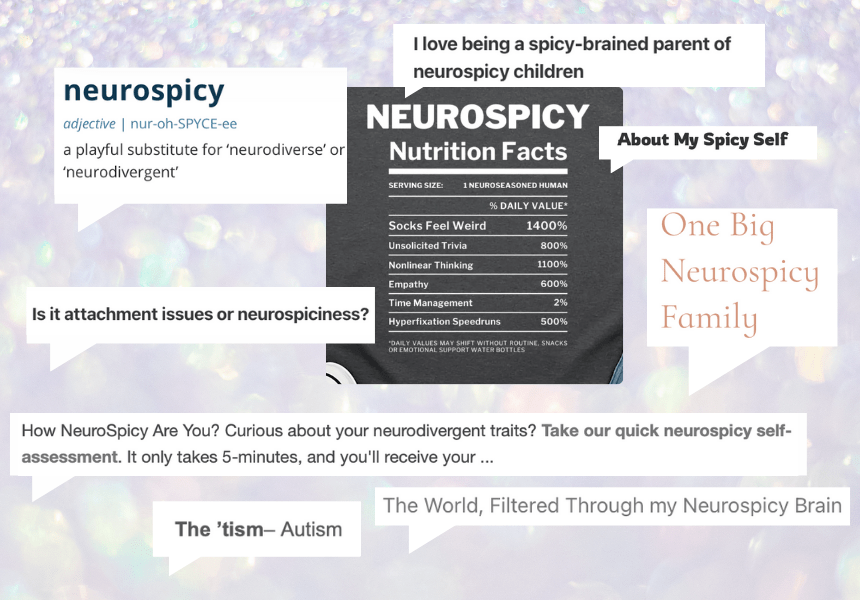
    I know Jessica meant no harm, just like everyone else who uses the term “neurospicy.” She probably thinks she’s raising awareness or lightening the mood, but she’s just making my eyes roll. I don’t enjoy sharing my label with people who use terms like “neurospicy.” I just don’t. It’s not funny to be Autistic, and my brain isn’t “spicy;” I’m disabled.

    “Whoa whoa! Why so serious?” You say, “disabled is a strong word.” Well, let’s look at that a little closer.

    There are two models to consider when defining a disability. The traditional medical model defines disability as some impairment that prevents someone from fully engaging in society. The social model of disability, in contrast, defines disability as differences that, because of society’s foundational prejudices, prevent someone from fully engaging in traditional daily life. I personally fall somewhere in the middle; disability is something that fundamentally alters the way you interact with the world, but those interactions are further altered by the social structures in place.

    Autism is, therefore, a disability for me. It influences how I work, how I study, how I spend my time, how I take care of myself, how I make friends, and how I date. A lot of these adaptations are invisible to others, but that doesn’t make them any less real to me. However, that invisibility makes it harder for people to conceptualize my Autism as a disability. I don’t claim that label on behalf of anybody else who is Autistic, but I do encourage you to think critically about why Autism being a disability, in cases such as mine, is an uncomfortable conclusion. I find that a lot of people like to forget I’m Autistic until it’s convenient for them or their needs. Would you rather I only embrace the “easy” parts of being Autistic? Would you like to have me as an inspiration, as a wallflower, as a mirrorball, as an advocate, and forget the rest of me? No. I have carved space with my bare hands, and I will not apologize for the dirt under my nails.

    Now that that’s out of the way, let’s address Jessica’s TikTok-ification of Autism.

    It’s weirdly humiliating. Autism has become a new punch line that strikes me square in the chest each time. An acquaintance uses Autistic as an adjective for someone who is “a little weird,” and all my friends turn to me, like they’re waiting to see how they should react, like the weight of Autism representation rests squarely on my shoulders. If I protest, if I try to explain, my words are minuscule in comparison to the number of memes they have seen that contradict me. It’s partly my fault. When someone says something hurtful unintentionally, I try to brush it off and move on. I like to give the benefit of the doubt that they are parroting the things they have heard before. I don’t stand up for myself nearly as often as I should. Instead, I pretend I don’t hear while my heart breaks inside. It’s also partly a broader problem that is a modern continuation of ableism; completely out of my hands and entirely too complex to unravel in less than a dissertation.

    Usually, I find the assimilation of online language into daily conversation to be a fascinating result of the fluidity of language and the strength of internet culture. We are amazing, adaptable creatures constantly seeking new ways to identify with each other, and language is a perfect tool to do so. In this case, though, the language being used to describe Autism is actively harmful not only to me but also to the whole community.


    There are a couple of reasons I hate these internet terms slung around to describe Autism.

    It promotes the stigma surrounding Autism and Autistic experiences by making people uncomfortable using real terms and discussing real elements of Autism.

    The more people use words like “neurospicy,” the less people are comfortable with the word Autism itself. The less comfortable people are with the word Autism, the less they’re willing to interact with Autism and, therefore, Autistic people. This cycle leads to disinterest at best, disgust at worst, and so the stigma against Autism grows.

    When I hear the word “neurospicy,” the first thing I think of is the overwhelming distress of a meltdown. When I meltdown, I lose control of my ability to speak, I cry uncontrollably, and I hyperventilate. Before I learned how to redirect my emotions, I used to hit myself (and sometimes I still want to) when I got overwhelmed. I have been in therapy since I was 9 years old and medicated since I was 16 years old to address my emotional regulation difficulties. That’s not “spicy,” that’s painful and real. Being afraid to talk about the ugly truths of Autism can only be stigmatizing.

    It reduces the reality of my diagnosis, my identity, and my lived experiences to a childish trend.

    Oftentimes, when people are using terms like “neurospicy,” they are, purposefully or inadvertently, presenting their audience with a version of Autism that is childish and simplistic. When something becomes trendy, it loses a lot of credibility. Even more so when that trend actively competes with the medical and social realities of a diagnosis. People have begun to treat the diagnosis of Autism as something you can opt into, meaning it should be just as easy, in their eyes, to opt out. People who don’t fit the social mould are seen as making a conscious choice to overstay their welcome and are treated as such.

    My experience being Autistic is unique. Many elements of my life shock non-Autistic people who are accustomed to the narrow definition presented on social media. I’m not alone; every Autistic person lives a life that stretches beyond what non-Autistic people think they can be. Stereotypes are claustrophobic, and pushing the boundaries of those stereotypes is exhausting. Instead of devoting energy to improving my quality of life, that same energy now flows into convincing people that I really am Autistic, despite what stereotypes would have you believe. “Neurospicy” is acceptable because stereotypes thrive, and stereotypes are reinforced because we promote them with terms like neurospicy. What a vicious cycle to contribute to.


    Look, I’m not the language police. You want to keep making videos and blog posts about “being a neurospicy person?” Fine. Do what you think raises awareness or lightens the mood or whatever. I’m also not saying there isn’t a space for comedy in being Autistic. I have heard some downright hilarious jokes made by and about Autistic people, but the funniest ones never punch down. What is there to laugh about in the fact that your audience is uncomfortable with the word Autistic?

    I’m very privileged to be a well-spoken, low-support needs Autistic person. I would be remiss if I didn’t use that privilege to tell you that your constant couching of Autism is only hurting how (not) seriously we are taken by non-Autistic people. The words we choose matter, especially when we have the weight of Autistic people who cannot as easily self-advocate on our shoulders.

    For the love of God, just say Autistic Jessica. You’d have no problem doing it as a punchline anyway.

  • What Could Be More Selfish Than That?

    What Could Be More Selfish Than That?

    “Selfish”: (of a person, action, or motive) lacking consideration for other people.

    Autistic people rarely get to be selfish.

    The existence of “accommodations” might lead you to believe that, actually, Autistic people are frequently selfish. After all, they are the ones asking the non-Autistic population to adjust their behaviours, right? However, consider how much and how often those same Autistic people are really the ones accommodating others. We are constantly masking ourselves to be more palatable. It’s not even asked of us; it’s assumed. We are also the ones living with the consequences of being unselfish, having a meltdown in the bathroom stall as quietly as possible before returning to the group.

    I can’t remember the last time I, as an Autistic person, unapologetically took up as much space as I needed. What I can remember is the last time I disassociated in public to cope with the overwhelming environment my friends chose as our hangout spot. We don’t consider driving a friend to the airport or bringing a coworker coffee a burden; we consider it a part of building a thriving community. So why is it that when suddenly it’s an Autistic person asking for something, it is an “accommodation?”

    Let’s look at an example in the form of “disclosing” autism. When I introduce myself to someone new, it usually comes up (as naturally as I can manage) that I’m Autistic. That’s because it is socially MY responsibility to inform others about my disability and MY responsibility to seek out accommodations. Consider that no one has to disclose they don’t like cold weather; they simply do what is best for themselves (in this case, wearing a jacket), and everyone accepts it. Know someone long enough and they don’t think twice about offering to let you borrow a pair of mittens when it snows. Someone with a peanut allergy isn’t asking for accommodations by choosing the nut-free meal at a restaurant; they’re just prioritizing their health and well-being.

    Disclosure is risky for Autistic people because of this lens of “selfishness” through which we view “accommodations.” If you really believe that Autistic people are protected in non-Autistic communities, then you don’t speak with enough Autistic people. The discrimination associated with Autism will compound when I disclose, all for the meagre reward of consideration.

    Autistic advocacy is another example. Too often, non-Autistic people will stretch the boundaries of what little advocacy space Autism receives to fit themselves in. In doing so, they are stepping on the toes of actual Autistic people. Caregivers are the ones expected to speak up because no one cares when the actual Autistic person wants or needs something. This means that, no matter how well-intentioned, caregivers default to the voice that advocates rather than the ear that listens. Not only is this infantilizing and even humiliating, but it also reinforces the abnormality of Autistic people speaking up and asking for things themselves.

    Every once in a while, someone will speak about “ways you can support your Autistic father, mother, child, partner, friend,” and everyone will applaud them for their stellar perspective on how ANOTHER person’s lived experience might affect them. Accommodations are always framed as the burden that one must bear in loving an Autistic person. Rather than tell them to kick rocks, Autistic people have to be graceful and delicate in their response. “Love this! Thank you for speaking up :)” We say as we watch the algorithm send their blog post into the spotlight while our own words stay stuck in the shadows. What becomes of our raw, human experiences is a watered-down, motivational anecdote about how we’re all in this together. It’s such a rare opportunity that we don’t want to scare away the few people trying to help. Still, it’s hard not to feel frustrated when I am once again smiling and nodding along to a presentation on neurodiversity that ends with the astounding revelation that Autistic people are human and therefore have human needs.

    A stereotype of Autism is that we lack empathy. I can’t speak for every Autistic person, but at least for myself, I sometimes feel I have too much empathy. I am caught up in how my existence, in its most natural form, might be inconveniencing or uncomfortable for others. Am I stimming too loudly? Am I moving in a distracting way? Do I seem rude if I put on my headphones? Should I laugh at the joke even if I don’t get it? I care more about how other people feel than I do about myself, and that often gets me into sticky situations. There are consequences to being selfless for Autistic people. Masking is exhausting, advocating is divisive, and disclosing can be dangerous. I say yes to things I want to say no to, and I don’t implement lifestyle changes that would genuinely relax and comfort me. It’s not that I lack empathy; it’s that I have a different style of communication, and therefore, my empathy is expressed differently.

    Non-Autistic people are privileged and, oftentimes, ignorant of that privilege. While I am counting the seconds of eye contact and thinking about where I’ve placed my hands in relation to their hands, they are solely invested in the act of building community on their terms. The majority of non-Autistic people do not adapt their behaviours or their environment to fit the needs of Autistic conversation partners, because they never consider that those needs might differ from their own. What can be more selfish than that?

    I think Autistic people should be as selfish as they want to be. They live in a world that isn’t built for them (if you subscribe to the social model of disability), and their attempts to self-advocate, even in minute ways, get labelled as “demands” or “adaptations” rather than as a natural variety in behaviour that exists among humans. Selfishness is a part of building community; it gives us the means to take care of ourselves. Without being selfish, how could we express and differentiate ourselves? How would we know who we love and who we tolerate? Everyone, not just Autistic people, deserves consideration from time to time. It is what keeps us safe, happy, and comfortable. And everyone, including Autistic people, deserves that for consideration not to be a big deal.

  • Why I Hate My Hometown

    Why I Hate My Hometown

    I’m back in London for a week in March.

    The weather is dull and grey when I arrive, and it feels comfortingly familiar. I missed it the way you miss cigarettes once you’ve quit smoking. Like you’re ready to throw away all the time apart just for one puff of nostalgia.

    That’s exactly how London feels to me, pure masochism under a thin layer of fondness. I look around and all I see are memories I would be better off forgetting and places I would be better off not revisiting (or vice versa).

    It’s fitting that to get to London I have a 10-hour commute, perfect to build the suspense. I spend the whole train ride there wondering what will become of me once I arrive. I always try to show up to my hometown with a positive outlook, but it’s hard when I know what’s coming. The same that always happens.

    Crossing county lines undoes the careful distance I’ve tried to place between who I am now and who I used to be; I find myself picking fights, ignoring friends, and skipping meals. How did I transform into a petulant teenager just five months shy of my 24th birthday?

    If there’s an opposite to rose-coloured glasses, that’s what I have when I’m in London. Everything looks dark and disappointing. There’s an LCBO at every corner calling my name and a growing homelessness problem that feels too overwhelming to even acknowledge. All of my friends have moved away, my ex lives too close for comfort, and, frankly, I am bored. I hate it here. Everything here hates me. Even the family dogs, who probably can see the tension in my face from the moment I enter the house.

    I am too awkward to fit into the clothes in my closet or the attitude I used to have. Still, when I’m in my hometown it’s all I have, so I wear it with my head held high, daring anyone to ask me why I haven’t grown up. Secretly though, I am deeply unsettled at the person I am when I am in London. I find her to be uptight, moody, and impulsive. The last time I was here I made some questionable decisions that included dyeing my hair red and sneaking out at 1AM. I don’t have any faith I am a smarter person than I was 6 months ago, but I find my way back to my hometown all the same.

    I think most of my negative perspective on London is self-flagellation in disguise. I tear myself down without mercy for the stupid things I did between the ages of 0 to 18, then tear myself down again for remembering them. Some might call it discipline but really it’s just rumination. I am my own worst critic; doomed to relive the fragmented memories ignited by the streets I pass as I drive around town.

    Something about London feels all-consuming, so I treat it as such. I’ve never had to act any differently. I always manage to escape the town I grew up in before it eats me whole. Since I know I will leave, I don’t have to self-reflect. I can come into London like a hurricane, knock everything off balance, and leave just as quickly as I came. Once I arrive back at my apartment in Montreal, I plead temporary insanity and move on.

    I used to tell my mom that I couldn’t wait to move away. True to my word, I left home at 18. Although my problems didn’t stay behind as expected, the worst of my mistakes could be easily passed over in the stories of my life when they weren’t as close. Even if I know it’s not true, the mentality that my problems are hidden in the dark corners of my childhood bedroom persists. I never thought to dig deeper than that, perfectly comfortable with the ‘big bad’ I had decreed London to be.

    I hate my hometown because it’s all I know about it.


    Why It’s Not That Bad (a reprise)

    I’m back in London for a weekend in July.

    I see my father for the first time in months, and we hug tightly. I smell like a musty train, but neither of us seems to care. My sister is having a baby, so we throw her a party and I gift her a onesie with a blue truck. We drive down to visit my brother and have dinner with my mother. Between bites of sushi, I talk fast and relish in our warm reunion. After a few days of cautious avoidance, the family dog sits beside me on the couch while my father and I watch an action movie. Overall, the trip goes well. I don’t smoke any cigarettes.

    On my last night sleeping in my childhood bed, I started to think back on all the times I’ve visited London since moving away. I always swear it’ll be worse than it ends up being, which makes me think about before I moved away. The moments that so closely mirror the very things that made this current trip enjoyable. There are memories galore to sift through of laughter and love. Just looking around my room reveals a treasure trove of random items that serve as reminders of good days. If London usually feels like a cigarette when you’re trying to quit, the emotions I feel now are like a breath of fresh air.

    Coming back from London, still with a brutal commute, I have a lot to consider. I know that the remnants of teenage angst have clouded my judgment in the past. I wonder why I sunk my teeth so deeply into resentment, why I am so comfortable tasting bitterness. I find it hard to take my previous petulance seriously as I wait for my connecting flight; it feels like I was someone else before. As an adult, I am no longer interested in stamping my feet and shaking my head just because my hometown has some problems attached to it. There is no reason to hold onto the hurt that I am healing from.

    Sure, I could still plead temporary insanity for some of the things I do when I’m home. Living out of a bag in my childhood room definitely brings out parts of me I thought I’d outgrown. I am a different person in London compared to Montreal, but does different mean worse? What’s more, I have to acknowledge my agency. I choose to come back to my hometown, which means I can choose who I am when I visit. Maybe the first step to learning to love my hometown is choosing to know my hometown.

    I won’t pretend I don’t have my reasons to hate it; there’s been a lot of bad things that happened there, but there’s also been a lot of good. I liked my childhood here. I had my first kiss at the local movie theatre. I worked my first minimum-wage job here. I went to prom in a dress I saved up all my money. I fell in love here with a boy who taught me important lessons. I learned what it meant to be a sister. I found a wonderful group of friends that I still visit in different cities. I graduated high school and walked across the stage with my head held high. It has the house I grew up in, the house I had my first party in, the house I found out I was leaving, the house I called home for 18 years.

    Maybe my hometown isn’t that bad, maybe I’m ready to get to know it.

    Dedicated to the people I love, who remind me of London in the best way.

  • Confessions of a Recovering Busy Girl

    Confessions of a Recovering Busy Girl

    Anyone who spends an extended period of time talking to me knows I’m a “busy girl.” It’s built into my identity at this point, rushing from one thing to the next or even juggling multiple things at once. Ask my roommate, and they’ll tell you it’s not unusual to see me typing away on my laptop at 11 PM on a Tuesday. It’s just who I am. 

    For the longest time, I took pride in being unreasonably, insanely, intensely busy. I had 5 categories on my Google calendar, colour-coded, and making a rainbow of my day from when I wake up well into the night. I used Notion like a prayer book, checking it religiously at the crossroads of any free time. If my day looked too empty, leaving me too much space for rumination (my Achilles heel), I rushed forward into a new to-do list or project to take up my time. It was a lot. 

    It’s not like I was inventing useless tasks either, my life does lend itself to a certain calibre of “busy.” I worked throughout my undergraduate (and now graduate) degree, part-time during the school semesters and full-time in the summers. I was Co-President of a club. I submitted freelance writing to various publication groups. I took a full course load and always submitted my assignments on time. I had a blossoming group of friends I would see in any free time I managed to squeeze in. I hosted private tutoring sessions as a side gig. I went on dates occasionally, sponsored by a boyfriend who begged to have my full attention for just one hour. No two tasks demanded the same things of me either; I had to be a completely different person hour to hour, day to day. Time off felt like a death sentence. My LinkedIn had never looked so exciting. 

    I wasn’t simply “busy,” I was running.

    Sometimes I would break down, crying on the floor of my living room and proclaiming I was tired of being a self-identified “busy girl.” It’s exhausting feeling like you’re a hamster running on a wheel, especially when you never take breaks. Yet, at the end of every evening of tears, I would wipe my face, open my laptop, and get started on the next thing. In a particularly busy period of my life, I set a timer for 30 minutes when I needed to cry, the alarm signalling the end of my allotted “feelings” time.

    Right now you’re probably thinking “holy shit.” Yeah, you and everyone else in my life. On one hand, it’s great to feel productive, you get to try so many new things and develop a robust skillset that looks great on your resume. On the other hand, it’s certainly not healthy to be so overtaken by productivity that you sacrifice your ability to relax. It caught up with me slowly, then all at once. My body started breaking down; I couldn’t sleep and barely ate (but that’s another story). I fell asleep in public, passing out from pure exhaustion at my desk.

    What took me 22 years and many, many therapy sessions to realize was that I wasn’t simply “busy,” I was running. Running away from my own mind. Running towards the next challenge. Running on the spot just because I didn’t know how to stop. Distraction is the default coping mechanism for a lot of people, mostly because it actually works if you don’t care about anything except the distractions. Underneath it all, though, I wanted to care about other things. I saw people laughing in public and craved to be in on the joke. I browsed library shelves, dreaming of a day when I read a silly book and I learned nothing profound. I called my mom to tell her this was really, truly the week where I took a day off. Wanting to care was the catalyst for the biggest, most productive thing I’ve ever done: nothing. I did it for an hour, then three hours, then a day. It sucked, then it didn’t, until it was actually pretty nice. “Nothing” is now an option when I’m choosing what to do in my free time. 

    I’m still busy, probably too much so. My ‘Extra Type A’ personality simply couldn’t let me be anything else. I still find myself opening my laptop to squeeze in 30 minutes of work on Tuesdays at 11 PM. I still have a (very) in-depth Notion to keep track of my life. Except now I’m trying to make my busyness more purposeful. Before, my anxiety was the driving force behind all my work. Now, that anxiety is still present, but I’m not gonna let it keep me on the hamster wheel full-time. I am learning that there is a balance inherent to productivity. I schedule in more time with friends, more time to write, more time to read, and even some time where I have no expectations at all. I take breaks while I’m working; I remember to get up and walk around, I remember to eat, to drink water, to smile. 

    I’ve been running for so long I have since forgotten where I set my first goal post.

    It’s scary, I won’t lie. I’ve never had this much free time before, and most of the time I don’t even know what to do with it. Still, I think it’s important to recognize how important relaxation is. My body, my mind both deserve rest. When you spend years straight on the go, you enter a perpetual fight or flight that interferes with your ability to enjoy life. How are you supposed to appreciate the feeling of fresh, warm bread or notice the first buds of spring if your ongoing monologue is “I just have to get this next thing done”?

    I also know I’m not the only “busy girl” out there. If you’ve ever caught yourself restarting your Pomodoro without taking that 5-minute break, you might be a busy girl too. It’s hard not to be in a world that seems to be perpetually demanding more, with numerous bids for your attention at every turn, but just because the world is going fast doesn’t mean you need to. There is a benefit in slowing down. Take the time to appreciate doing nothing, and maybe it’ll turn into something. I’m writing this much for myself as for someone else— this is just one big bid for accountability. Maybe if I transform my thoughts into writing and send them out into the ether, I’ll feel a responsibility towards what I’ve noted down. I’ve been running for so long, I have since forgotten where I set my first goal post, so does it matter if I reach the next one? As much as I find relaxation a chore, I can hope it’ll get easier with time and I’ll be able to reap the benefits of all this discomfort. 

    I don’t want to run anymore, I want to live.