Tag: feminism

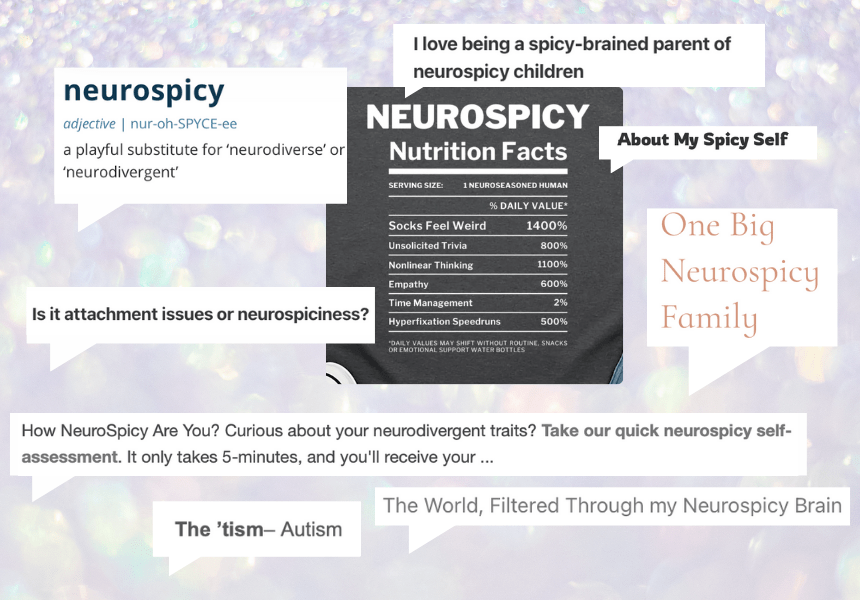
  • You’re not “neurospicy” Jessica, you’re disabled.

    You’re not “neurospicy” Jessica, you’re disabled.

    I’m writing to a non-existent Autistic woman named Jessica. I came across her writing piece today describing the experience of being a late-diagnosed Autistic woman. I am always looking for a deeper connection to the label I feel defined by, so, of course, I was elated. Almost immediately, though, I read the catchline: “for my neurospicy girls!”

    Gag me.

    I know Jessica meant no harm, just like everyone else who uses the term “neurospicy.” She probably thinks she’s raising awareness or lightening the mood, but she’s just making my eyes roll. I don’t enjoy sharing my label with people who use terms like “neurospicy.” I just don’t. It’s not funny to be Autistic, and my brain isn’t “spicy;” I’m disabled.

    “Whoa whoa! Why so serious?” You say, “disabled is a strong word.” Well, let’s look at that a little closer.

    There are two models to consider when defining a disability. The traditional medical model defines disability as some impairment that prevents someone from fully engaging in society. The social model of disability, in contrast, defines disability as differences that, because of society’s foundational prejudices, prevent someone from fully engaging in traditional daily life. I personally fall somewhere in the middle; disability is something that fundamentally alters the way you interact with the world, but those interactions are further altered by the social structures in place.

    Autism is, therefore, a disability for me. It influences how I work, how I study, how I spend my time, how I take care of myself, how I make friends, and how I date. A lot of these adaptations are invisible to others, but that doesn’t make them any less real to me. However, that invisibility makes it harder for people to conceptualize my Autism as a disability. I don’t claim that label on behalf of anybody else who is Autistic, but I do encourage you to think critically about why Autism being a disability, in cases such as mine, is an uncomfortable conclusion. I find that a lot of people like to forget I’m Autistic until it’s convenient for them or their needs. Would you rather I only embrace the “easy” parts of being Autistic? Would you like to have me as an inspiration, as a wallflower, as a mirrorball, as an advocate, and forget the rest of me? No. I have carved space with my bare hands, and I will not apologize for the dirt under my nails.

    Now that that’s out of the way, let’s address Jessica’s TikTok-ification of Autism.

    It’s weirdly humiliating. Autism has become a new punch line that strikes me square in the chest each time. An acquaintance uses Autistic as an adjective for someone who is “a little weird,” and all my friends turn to me, like they’re waiting to see how they should react, like the weight of Autism representation rests squarely on my shoulders. If I protest, if I try to explain, my words are minuscule in comparison to the number of memes they have seen that contradict me. It’s partly my fault. When someone says something hurtful unintentionally, I try to brush it off and move on. I like to give the benefit of the doubt that they are parroting the things they have heard before. I don’t stand up for myself nearly as often as I should. Instead, I pretend I don’t hear while my heart breaks inside. It’s also partly a broader problem that is a modern continuation of ableism; completely out of my hands and entirely too complex to unravel in less than a dissertation.

    Usually, I find the assimilation of online language into daily conversation to be a fascinating result of the fluidity of language and the strength of internet culture. We are amazing, adaptable creatures constantly seeking new ways to identify with each other, and language is a perfect tool to do so. In this case, though, the language being used to describe Autism is actively harmful not only to me but also to the whole community.


    There are a couple of reasons I hate these internet terms slung around to describe Autism.

    It promotes the stigma surrounding Autism and Autistic experiences by making people uncomfortable using real terms and discussing real elements of Autism.

    The more people use words like “neurospicy,” the less people are comfortable with the word Autism itself. The less comfortable people are with the word Autism, the less they’re willing to interact with Autism and, therefore, Autistic people. This cycle leads to disinterest at best, disgust at worst, and so the stigma against Autism grows.

    When I hear the word “neurospicy,” the first thing I think of is the overwhelming distress of a meltdown. When I meltdown, I lose control of my ability to speak, I cry uncontrollably, and I hyperventilate. Before I learned how to redirect my emotions, I used to hit myself (and sometimes I still want to) when I got overwhelmed. I have been in therapy since I was 9 years old and medicated since I was 16 years old to address my emotional regulation difficulties. That’s not “spicy,” that’s painful and real. Being afraid to talk about the ugly truths of Autism can only be stigmatizing.

    It reduces the reality of my diagnosis, my identity, and my lived experiences to a childish trend.

    Oftentimes, when people are using terms like “neurospicy,” they are, purposefully or inadvertently, presenting their audience with a version of Autism that is childish and simplistic. When something becomes trendy, it loses a lot of credibility. Even more so when that trend actively competes with the medical and social realities of a diagnosis. People have begun to treat the diagnosis of Autism as something you can opt into, meaning it should be just as easy, in their eyes, to opt out. People who don’t fit the social mould are seen as making a conscious choice to overstay their welcome and are treated as such.

    My experience being Autistic is unique. Many elements of my life shock non-Autistic people who are accustomed to the narrow definition presented on social media. I’m not alone; every Autistic person lives a life that stretches beyond what non-Autistic people think they can be. Stereotypes are claustrophobic, and pushing the boundaries of those stereotypes is exhausting. Instead of devoting energy to improving my quality of life, that same energy now flows into convincing people that I really am Autistic, despite what stereotypes would have you believe. “Neurospicy” is acceptable because stereotypes thrive, and stereotypes are reinforced because we promote them with terms like neurospicy. What a vicious cycle to contribute to.


    Look, I’m not the language police. You want to keep making videos and blog posts about “being a neurospicy person?” Fine. Do what you think raises awareness or lightens the mood or whatever. I’m also not saying there isn’t a space for comedy in being Autistic. I have heard some downright hilarious jokes made by and about Autistic people, but the funniest ones never punch down. What is there to laugh about in the fact that your audience is uncomfortable with the word Autistic?

    I’m very privileged to be a well-spoken, low-support needs Autistic person. I would be remiss if I didn’t use that privilege to tell you that your constant couching of Autism is only hurting how (not) seriously we are taken by non-Autistic people. The words we choose matter, especially when we have the weight of Autistic people who cannot as easily self-advocate on our shoulders.

    For the love of God, just say Autistic Jessica. You’d have no problem doing it as a punchline anyway.
  • What Could Be More Selfish Than That?

    What Could Be More Selfish Than That?

    “Selfish”: (of a person, action, or motive) lacking consideration for other people.

    Autistic people rarely get to be selfish.

    The existence of “accommodations” might lead you to believe that, actually, Autistic people are frequently selfish. After all, they are the ones asking the non-Autistic population to adjust their behaviours, right? However, consider how much and how often those same Autistic people are really the ones accommodating others. We are constantly masking ourselves to be more palatable. It’s not even asked of us; it’s assumed. We are also the ones living with the consequences of being unselfish, having a meltdown in the bathroom stall as quietly as possible before returning to the group.

    I can’t remember the last time I, as an Autistic person, unapologetically took up as much space as I needed. What I can remember is the last time I disassociated in public to cope with the overwhelming environment my friends chose as our hangout spot. We don’t consider driving a friend to the airport or bringing a coworker coffee a burden; we consider it a part of building a thriving community. So why is it that when suddenly it’s an Autistic person asking for something, it is an “accommodation?”

    Let’s look at an example in the form of “disclosing” autism. When I introduce myself to someone new, it usually comes up (as naturally as I can manage) that I’m Autistic. That’s because it is socially MY responsibility to inform others about my disability and MY responsibility to seek out accommodations. Consider that no one has to disclose they don’t like cold weather; they simply do what is best for themselves (in this case, wearing a jacket), and everyone accepts it. Know someone long enough and they don’t think twice about offering to let you borrow a pair of mittens when it snows. Someone with a peanut allergy isn’t asking for accommodations by choosing the nut-free meal at a restaurant; they’re just prioritizing their health and well-being.

    Disclosure is risky for Autistic people because of this lens of “selfishness” through which we view “accommodations.” If you really believe that Autistic people are protected in non-Autistic communities, then you don’t speak with enough Autistic people. The discrimination associated with Autism will compound when I disclose, all for the meagre reward of consideration.

    Autistic advocacy is another example. Too often, non-Autistic people will stretch the boundaries of what little advocacy space Autism receives to fit themselves in. In doing so, they are stepping on the toes of actual Autistic people. Caregivers are the ones expected to speak up because no one cares when the actual Autistic person wants or needs something. This means that, no matter how well-intentioned, caregivers default to the voice that advocates rather than the ear that listens. Not only is this infantilizing and even humiliating, but it also reinforces the abnormality of Autistic people speaking up and asking for things themselves.

    Every once in a while, someone will speak about “ways you can support your Autistic father, mother, child, partner, friend,” and everyone will applaud them for their stellar perspective on how ANOTHER person’s lived experience might affect them. Accommodations are always framed as the burden that one must bear in loving an Autistic person. Rather than tell them to kick rocks, Autistic people have to be graceful and delicate in their response. “Love this! Thank you for speaking up :)” We say as we watch the algorithm send their blog post into the spotlight while our own words stay stuck in the shadows. What becomes of our raw, human experiences is a watered-down, motivational anecdote about how we’re all in this together. It’s such a rare opportunity that we don’t want to scare away the few people trying to help. Still, it’s hard not to feel frustrated when I am once again smiling and nodding along to a presentation on neurodiversity that ends with the astounding revelation that Autistic people are human and therefore have human needs.

    A stereotype of Autism is that we lack empathy. I can’t speak for every Autistic person, but at least for myself, I sometimes feel I have too much empathy. I am caught up in how my existence, in its most natural form, might be inconveniencing or uncomfortable for others. Am I stimming too loudly? Am I moving in a distracting way? Do I seem rude if I put on my headphones? Should I laugh at the joke even if I don’t get it? I care more about how other people feel than I do about myself, and that often gets me into sticky situations. There are consequences to being selfless for Autistic people. Masking is exhausting, advocating is divisive, and disclosing can be dangerous. I say yes to things I want to say no to, and I don’t implement lifestyle changes that would genuinely relax and comfort me. It’s not that I lack empathy; it’s that I have a different style of communication, and therefore, my empathy is expressed differently.

    Non-Autistic people are privileged and, oftentimes, ignorant of that privilege. While I am counting the seconds of eye contact and thinking about where I’ve placed my hands in relation to their hands, they are solely invested in the act of building community on their terms. The majority of non-Autistic people do not adapt their behaviours or their environment to fit the needs of Autistic conversation partners, because they never consider that those needs might differ from their own. What can be more selfish than that?

    I think Autistic people should be as selfish as they want to be. They live in a world that isn’t built for them (if you subscribe to the social model of disability), and their attempts to self-advocate, even in minute ways, get labelled as “demands” or “adaptations” rather than as a natural variety in behaviour that exists among humans. Selfishness is a part of building community; it gives us the means to take care of ourselves. Without being selfish, how could we express and differentiate ourselves? How would we know who we love and who we tolerate? Everyone, not just Autistic people, deserves consideration from time to time. It is what keeps us safe, happy, and comfortable. And everyone, including Autistic people, deserves that for consideration not to be a big deal.

  • Sex, the Self, and the Sorts of It

    Sex, the Self, and the Sorts of It

    To be a woman is to be suspended in a space between ‘whore’ and ‘prude,’ where our very existence revolves around our ‘performance.’ Exposure to societal pressures manipulates many into internalizing and replicating an ‘adequate’ sexuality. Whether this be in our behaviours or beliefs, we become imitations of the ‘ideal woman’ rather than an individual identity. In instances of self-determination, the lens of male pleasure corrupts any actions into demonstrations of our sexuality. As we wear school uniforms and chew gum, we are categorized by every person we encounter and then shamed for these supposed displays of sexuality. It is impossible for a woman to have casual sex or wear a tight dress to the bar without receiving social correction in the form of slut-shaming or harassment.

    The idea of ‘sexual liberation’ of women arose from the collective frustration felt by women experiencing sexual violence and shaming. There is hardly a step-by-step handbook to sexual liberation, but many feminists agree that by removing performatism from sex, investing in the self, and rejecting the labels placed unto us, we are (in theory) free to express our sexuality in any form we so choose. Of course, there are various ways to define liberation.

    Is liberation about learning not to care, learning to ignore, learning to enjoy, learning to vocalize, or something else entirely?

    The era of feminism plays a role in this interpretation; second wave feminists understand liberation to be a fought-for privilege, while recent discussions by third-wave feminists question if the act of having sex in itself is a sufficient solution to toxic sexuality. This can be observed in the treatment of pop stars like Britney Spears, where calls to let them ‘express themselves’ and sing about the things they do in the bedroom have morphed into questions about the commodification of their sexuality. What was once a victory for women’s rights has now been appropriated to be a roadblock to further progress.

    This appropriation was not adopted by the feminists outlining boundaries in their own sex lives and identities, but rather by a wider patriarchal society putting up barriers to progress and capitalizing on fake ‘sexual liberation.’

    Toxic sexuality begins with the idea that sex, and therefore your sexual identity, has boundaries that make it ‘right’ or wrong.’ From there, any action
    that implies ‘sex’ must be held under a magnifying glass and scrutinized. Since there is no consensus on what ‘good’ sexuality is, the label of ‘bad’ is frequently assigned as a reminder of the ways in which sex is shameful and crude. Women have a lower ability to express acceptable sexuality, but are held to a higher standard of performance when they do act sexually. Despite being barred from feeling pleasure, we must know exactly what ways it should be provided and we must always provide it correctly. While we must have the hidden talents of a porn star, no one should be able to guess it by knowing us. Women are as sexual as others judge them to be, but with a hypersexual lens, all innocent actions are perceived as purposefully erotic.

    If you are expected to have sex, can you still participate in it while rejecting those same expectations?

    Back in 2014, Rachel Hills did a piece for Time Magazine examining the longstanding debate on modesty vs immodesty and the little progress made in the past 100 years in finding the ‘appropriate’ level of sexuality. It’s depressing to see how little has changed in the 10 years since its publication. Some suggested that sexual liberation begins with refusing to express sexuality and believe that modesty can cure hypersexualization. Others argued modesty only feeds into sexual repression and that women should be embracing hypersexuality as the healthier alternative. Either way, this removes the individual choice and invites the woman to put on a display for the masses’ critique. Not only does this contradict the original message of sexual freedom, but the demand for a uniform ‘amount’ of sexuality discourages women from exploring the full range of their sexuality. Sexual liberation is not necessarily the normative sexual experience; sex is different for different identities and lived experiences. Without healthy exploration, sexuality becomes exclusive to the able-bodied and heteronormative.

    Sexual liberation also acts as an excuse for sexual exploitation; young women are pressured into expressing their sexuality by predatory men who pretend that their intentions are about ‘freedom,’ and many acceptable forms of desire rely on violence against women as a source of pleasure for men. It is draining to separate genuine sexual expression from sexual performance. In theory, it must be purposeful, independent, and self-fulfilling, but in practice it is rartely any of the three.

    In contrast to women’s contributions, men’s historical role as the perpetrators and benefactors of female oppression bars them from participating in this revolution. Most men are eager to categorize ‘prudes’ and ‘whores’ but are reluctant to admit their exemption from these standards. When men are permitted to dictate the boundaries of a woman’s sexuality, through media, relationships, work, or otherwise, it strips the woman of her individuality. The concept of sexual freedom is already so frequently watered down to appease the male palate that any demand for meaningful contribution from men will solely result in the reintroduction of patriarchal values.

    This should not to be misunderstood as a criticism of sexuality, but rather a question of how quickly the idea of the sexually liberated woman becomes exclusively associated with the (right) sexual woman. This article also deliberately vague on what a woman’s sexuality should be or how it should be expressed. This is because the only reasonable conclusion is that women should approach their sexuality with curiosity and warmth, regardless of the wider preconceived notions of healthy sexuality or ‘obligations’ to feminism. It is not about men’s opinions or the patriarchal values they parrot, just like sexual liberation never has been.

    Originally published in the F(eminist)-Word in 2022.

  • ‘Madness’, Medical Misogyny and Misdiagnoses: The Woes of the Chronically Ill Woman

    ‘Madness’, Medical Misogyny and Misdiagnoses: The Woes of the Chronically Ill Woman

    During my childhood, I can remember doctors dismissing my mother every time she brought up something about my health that was worrying her. It’s just growing pains. Kids hurt themselves all the time. She needs to get out more. It’s a bad cold. One doctor even suggested my hands’ recent malfunctions were because of my parents’ divorce (that happened when I was six)!

    In the eyes of my doctors, I went from an accident-prone kid to a mentally-ill teenager.

    When I was old enough to go to my appointments on my own, my mother resisted it. She was never the kind of mother to stop me from exploring my independence, so her diligence about the doctor’s office seemed weirdly out of character. ‘You know what you’re going to say, right? Don’t leave until they listen to you. Repeat exactly what you told me. Don’t take no for an answer. Trust what you are feeling and trust your body.’ I thought she was a hypochondriac, and so did my family doctor.

    They were relieved to deal with me instead of her. I would smile and nod along with whatever they said without ever asking questions. I didn’t understand what my mother had been trying to teach me. I let a lot of professionals tell me I was perfectly healthy even though I was struggling because I trusted them to know my body best. I got used to thinking, ‘that’s weird’, and going about my day in situations where most people would rush to a walk-in clinic.

    It only got worse as I aged. In the eyes of my doctors, I went from an accident-prone kid to a mentally-ill teenager. Every illness, pain and problem could be chalked up to the burden of puberty and a turbulent social life. When I complained about fatigue and a lack of sleep, I got lectured on bad sleep hygiene, but no one ever asked why a sixteen-year-old could sleep from 10 pm to 3 pm without stirring. Each month I wondered if I would mistake my appendix bursting for cramps because I was told periods hurt for everyone. My therapist suggested I try meditating and deep breathing, but I still ended every day feeling like I had been hit by a truck.

    Frustration bubbled in me from sixteen to nineteen years old. The doctors I saw didn’t see anything wrong with me. Every test came back normal. Eventually, they stopped listening to my symptoms altogether. I got a strong muscle relaxer to target my headaches and reboot my sleep schedule, and every new pain was solved by upping my dosage and drinking more water.

    After I aged out of my paediatric office, I resorted to going to walk-ins and demanding someone pay attention to me, damn it. After years of overworking my liver without any improvement, I weaned myself off my medication and started journaling the ebbs and flows of my body. For nearly two years, I’ve been bouncing from doctor to doctor. All the while, my body is breaking down even more.

    The fight is exhausting, but what makes it worse is that no one believes me. It’s the thing my mother wanted to hide from me, though she couldn’t make the world change overnight. I am graced with labels like ‘hysterical,’ ‘stressed,’ ‘mentally ill,’ and ‘sensitive,’ never to be heard and never to be believed.

    The fastest way to get more tests was to take up space in these offices that didn’t want me, plant my feet, and refuse to leave until someone gave me the courtesy of a reference. Like my mother had hoped, I learned to stand up for myself. But neither of us expected how little it would end up mattering. I was denied my medical records, had my appointments cancelled, placed on endless holds, hung up on, and abandoned by the places meant to give me answers.

    She gave me her spirit and her stubbornness – I used them every day.

    Through it all, my mother held my hand and rubbed my back. She told me I was strong, that this moment would pass; things would hurt less tomorrow. She drove me to doctor’s appointments and hugged me while I broke down in parking lots out of frustration. When I begged her to let me give up, she reminded me how much more fight I had in me. She gave me her spirit and her stubbornness – I used them every day.

    Sometimes we reminisce about all the places we have been and the things we have tried in order to fix my broken body. We can laugh at the ridiculously sexist things I have been told and the nonsensical diagnoses doctors have given me to usher me out the door faster. Secretly though, I know it hurts her to see how much I’m hurting. She calls me a piece of herself that she happily gave away; she feels all my pain as if it were her own.

    We both blame ourselves for the doctors of my youth and the failures of our medical system. Had she dragged along my father, taken up more space, demanded more things, cried, screamed, and sat on the floor of my doctor’s office, maybe I wouldn’t be the one doing these things today. Unfortunately, it wouldn’t have mattered either way.

    We are women, I am chronically ill, and no amount of advocacy or motherly protection could have saved me.

    Originally published on Heroica Women.