Tag: life

  • It Won’t Kill You (Until It Does)

    It Won’t Kill You (Until It Does)

    Tip: Writing about being 19 might make you feel 19, but you’re still 24.

    I’ve been holding off on talking about my eating disorder for the past few years. I’m nearing 7 years in recovery. Why haven’t I passed the time writing essay after essay about how brave I am for overcoming the most deadly mental illness in the world? Especially considering how freely I will voice my opinion on other matters and how much admiration I hold for others fighting these same battles.

    Primarily, it’s because I don’t really subscribe to the narrative that I’m powerful and inspiring for managing my mental health, nor do I think it gives me some magical insight that requires others to pay attention to me. Nothing I have to say about eating disorders is profound or unique; I am one of 30 million women who will struggle with an eating disorder in their life.

    I also struggle to write about it because I used to read about it. A lot. If you weren’t around for Tumblr’s golden age, you might have missed out on the very insidious content of models contorted into humiliating poses with a Picsart grunge filter smashed on top. To the untrained eye, it’s just weird university students testing out a new hobby. To me, though, it meant everything. I worshipped these women as my idols; their bodies were works of art I was dedicating my life to replicating with shaky hands.

    Even once I started therapy, I would scour recovery content, looking for any “trade secrets” these people accidentally let slip. You told me you did X to show how ridiculous you were acting back then, but now all I can think of is how I should try X to see if it works. Even if the content was a 10-minute video of a woman explaining exactly how her eating disorder ruined her life, all I heard was “blah blah THIS IS MY WEIGHT blah blah BIG/SMALL NUMBERS blah blah LOOK AT MY BODY.”

    Video after video, post after post, book after book; if I just read the right inspirational quote, I would surely find the strength to battle my inner demons, right? I tricked myself into believing that I was doing something good by constantly, incessantly consuming media about eating disorders. I don’t write about eating disorders because I know all too well that even the most well-meaning message is going to be corrupted in the eyes of someone’s eating disorder.

    There’s one more reason why I don’t write about eating disorders, and it’s a doozy. Some of the worst moments of my life happened because I had an eating disorder. Not all of them, but enough that I get uncomfortable addressing my past behaviours and the kinds of thoughts that arose as a result of my severe mental illness. I did and said some truly heinous things in the name of my eating disorder, and I feel a lot of shame about them. It feels awkward admitting that not only did I have an eating disorder, but I was kind of a shitty person because of my eating disorder.

    For me, there’s a delicate balance between acknowledging my mistakes and self-flagellation; just like there’s a delicate balance between excusing shitty behaviour and forgiveness. When you have an eating disorder, your brain is literally starving itself back into a child-like state. What little energy you have gets diverted from those valuable skills of critical thinking and logic into the basic human functions. This leads to a lot of poor decisions and vulnerability, which affects everyone who is watching in horror as you drop a nuke on your life. As I’ve already said, I won’t be divulging the details of my eating disorder to anyone except a licensed therapist, but trust me that they happened.


    Now for the twist: Yes, I don’t want to talk about my eating disorder, and yet I am writing this today. Eating disorders are inherently contradictory, and I guess so am I. At least I’m self-aware, right? My current position (with no promises I won’t change my mind tomorrow) is that even if I have my reservations, there is something serious happening that needs to be addressed.

    Thanks to extensive therapy, I am trained to recognize the patterns that crop up right before my eating disorder makes its grand entrance. It concerns me that what was once inside my head is being mirrored in the world around me. There’s been an uptick in discourse surrounding eating disorders, at least for someone with their finger on the pulse (perhaps you never really move on?). It feels like a resurrection of a truly dark cultural movement that will inevitably steal the youth of millions of girls, if not their lives. What used to be called ‘coke-skinny’ is now being called ‘ozempic-skinny’, but it’s all the same cancer. We are watching celebrities shrink at alarming rates, our medical system is collapsing, and food costs are rising. Blink, and you miss it, but suddenly we are living in one of those self-sufficient terrariums with eating disorders breeding like mold. How are we supposed to take care of ourselves in these conditions?

    Still, I do. I begrudgingly do the work every day to make sure I am never in the position to lose myself so completely to my mental illness again. I write myself love letters on post-it notes and stick them around my room when I’m feeling self-critical. I repeat the mantras gifted to me by wiser women about taking up the space I deserve and never accepting less than “enough”. I turn dinner time into celebrations of friendship and love. I act on my hunger: for opportunities, for knowledge, for nachos, for even better days.

    I won’t pretend I’m perfect to sell the dream of “recovery”. I will promise that life gets a little easier on the exact day that choosing to get better isn’t even a choice anymore, it’s the only option.

    The brutal, honest truth is that I don’t have any kind of solution right now. I’m treading water just like everyone else, amidst diet pills and the press junket for Wicked. Still, I feel better in my body than I ever have before because of those first steps I took 7 years ago. Maybe someday I’ll have something more profound or inspiring to say about my experience having an eating disorder. For right now, all I really care about is being a voice on the side of getting better.

    If I haven’t made it explicit enough, eating disorders will ruin your life. You will not get relief by hurting yourself. When you brush fingertips against death, you will only want to grab it with both hands. You need to get better. You need to want to get better. You need to choose to get better. If you don’t choose it today, there will be fewer tomorrows.

    Tip: Having an eating disorder won’t kill you. Until it does.

  • You’re not “neurospicy” Jessica, you’re disabled.

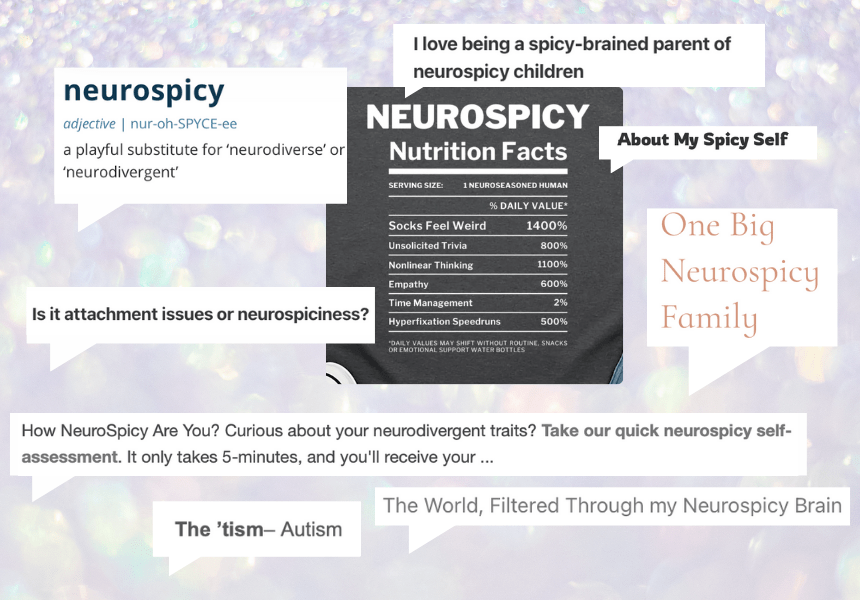
    You’re not “neurospicy” Jessica, you’re disabled.

    I’m writing to a non-existent Autistic woman named Jessica. I came across her writing piece today describing the experience of being a late-diagnosed Autistic woman. I am always looking for a deeper connection to the label I feel defined by, so, of course, I was elated. Almost immediately, though, I read the catchline: “for my neurospicy girls!”

    Gag me.

    I know Jessica meant no harm, just like everyone else who uses the term “neurospicy.” She probably thinks she’s raising awareness or lightening the mood, but she’s just making my eyes roll. I don’t enjoy sharing my label with people who use terms like “neurospicy.” I just don’t. It’s not funny to be Autistic, and my brain isn’t “spicy;” I’m disabled.

    “Whoa whoa! Why so serious?” You say, “disabled is a strong word.” Well, let’s look at that a little closer.

    There are two models to consider when defining a disability. The traditional medical model defines disability as some impairment that prevents someone from fully engaging in society. The social model of disability, in contrast, defines disability as differences that, because of society’s foundational prejudices, prevent someone from fully engaging in traditional daily life. I personally fall somewhere in the middle; disability is something that fundamentally alters the way you interact with the world, but those interactions are further altered by the social structures in place.

    Autism is, therefore, a disability for me. It influences how I work, how I study, how I spend my time, how I take care of myself, how I make friends, and how I date. A lot of these adaptations are invisible to others, but that doesn’t make them any less real to me. However, that invisibility makes it harder for people to conceptualize my Autism as a disability. I don’t claim that label on behalf of anybody else who is Autistic, but I do encourage you to think critically about why Autism being a disability, in cases such as mine, is an uncomfortable conclusion. I find that a lot of people like to forget I’m Autistic until it’s convenient for them or their needs. Would you rather I only embrace the “easy” parts of being Autistic? Would you like to have me as an inspiration, as a wallflower, as a mirrorball, as an advocate, and forget the rest of me? No. I have carved space with my bare hands, and I will not apologize for the dirt under my nails.

    Now that that’s out of the way, let’s address Jessica’s TikTok-ification of Autism.

    It’s weirdly humiliating. Autism has become a new punch line that strikes me square in the chest each time. An acquaintance uses Autistic as an adjective for someone who is “a little weird,” and all my friends turn to me, like they’re waiting to see how they should react, like the weight of Autism representation rests squarely on my shoulders. If I protest, if I try to explain, my words are minuscule in comparison to the number of memes they have seen that contradict me. It’s partly my fault. When someone says something hurtful unintentionally, I try to brush it off and move on. I like to give the benefit of the doubt that they are parroting the things they have heard before. I don’t stand up for myself nearly as often as I should. Instead, I pretend I don’t hear while my heart breaks inside. It’s also partly a broader problem that is a modern continuation of ableism; completely out of my hands and entirely too complex to unravel in less than a dissertation.

    Usually, I find the assimilation of online language into daily conversation to be a fascinating result of the fluidity of language and the strength of internet culture. We are amazing, adaptable creatures constantly seeking new ways to identify with each other, and language is a perfect tool to do so. In this case, though, the language being used to describe Autism is actively harmful not only to me but also to the whole community.


    There are a couple of reasons I hate these internet terms slung around to describe Autism.

    It promotes the stigma surrounding Autism and Autistic experiences by making people uncomfortable using real terms and discussing real elements of Autism.

    The more people use words like “neurospicy,” the less people are comfortable with the word Autism itself. The less comfortable people are with the word Autism, the less they’re willing to interact with Autism and, therefore, Autistic people. This cycle leads to disinterest at best, disgust at worst, and so the stigma against Autism grows.

    When I hear the word “neurospicy,” the first thing I think of is the overwhelming distress of a meltdown. When I meltdown, I lose control of my ability to speak, I cry uncontrollably, and I hyperventilate. Before I learned how to redirect my emotions, I used to hit myself (and sometimes I still want to) when I got overwhelmed. I have been in therapy since I was 9 years old and medicated since I was 16 years old to address my emotional regulation difficulties. That’s not “spicy,” that’s painful and real. Being afraid to talk about the ugly truths of Autism can only be stigmatizing.

    It reduces the reality of my diagnosis, my identity, and my lived experiences to a childish trend.

    Oftentimes, when people are using terms like “neurospicy,” they are, purposefully or inadvertently, presenting their audience with a version of Autism that is childish and simplistic. When something becomes trendy, it loses a lot of credibility. Even more so when that trend actively competes with the medical and social realities of a diagnosis. People have begun to treat the diagnosis of Autism as something you can opt into, meaning it should be just as easy, in their eyes, to opt out. People who don’t fit the social mould are seen as making a conscious choice to overstay their welcome and are treated as such.

    My experience being Autistic is unique. Many elements of my life shock non-Autistic people who are accustomed to the narrow definition presented on social media. I’m not alone; every Autistic person lives a life that stretches beyond what non-Autistic people think they can be. Stereotypes are claustrophobic, and pushing the boundaries of those stereotypes is exhausting. Instead of devoting energy to improving my quality of life, that same energy now flows into convincing people that I really am Autistic, despite what stereotypes would have you believe. “Neurospicy” is acceptable because stereotypes thrive, and stereotypes are reinforced because we promote them with terms like neurospicy. What a vicious cycle to contribute to.


    Look, I’m not the language police. You want to keep making videos and blog posts about “being a neurospicy person?” Fine. Do what you think raises awareness or lightens the mood or whatever. I’m also not saying there isn’t a space for comedy in being Autistic. I have heard some downright hilarious jokes made by and about Autistic people, but the funniest ones never punch down. What is there to laugh about in the fact that your audience is uncomfortable with the word Autistic?

    I’m very privileged to be a well-spoken, low-support needs Autistic person. I would be remiss if I didn’t use that privilege to tell you that your constant couching of Autism is only hurting how (not) seriously we are taken by non-Autistic people. The words we choose matter, especially when we have the weight of Autistic people who cannot as easily self-advocate on our shoulders.

    For the love of God, just say Autistic Jessica. You’d have no problem doing it as a punchline anyway.

  • What Could Be More Selfish Than That?

    What Could Be More Selfish Than That?

    “Selfish”: (of a person, action, or motive) lacking consideration for other people.

    Autistic people rarely get to be selfish.

    The existence of “accommodations” might lead you to believe that, actually, Autistic people are frequently selfish. After all, they are the ones asking the non-Autistic population to adjust their behaviours, right? However, consider how much and how often those same Autistic people are really the ones accommodating others. We are constantly masking ourselves to be more palatable. It’s not even asked of us; it’s assumed. We are also the ones living with the consequences of being unselfish, having a meltdown in the bathroom stall as quietly as possible before returning to the group.

    I can’t remember the last time I, as an Autistic person, unapologetically took up as much space as I needed. What I can remember is the last time I disassociated in public to cope with the overwhelming environment my friends chose as our hangout spot. We don’t consider driving a friend to the airport or bringing a coworker coffee a burden; we consider it a part of building a thriving community. So why is it that when suddenly it’s an Autistic person asking for something, it is an “accommodation?”

    Let’s look at an example in the form of “disclosing” autism. When I introduce myself to someone new, it usually comes up (as naturally as I can manage) that I’m Autistic. That’s because it is socially MY responsibility to inform others about my disability and MY responsibility to seek out accommodations. Consider that no one has to disclose they don’t like cold weather; they simply do what is best for themselves (in this case, wearing a jacket), and everyone accepts it. Know someone long enough and they don’t think twice about offering to let you borrow a pair of mittens when it snows. Someone with a peanut allergy isn’t asking for accommodations by choosing the nut-free meal at a restaurant; they’re just prioritizing their health and well-being.

    Disclosure is risky for Autistic people because of this lens of “selfishness” through which we view “accommodations.” If you really believe that Autistic people are protected in non-Autistic communities, then you don’t speak with enough Autistic people. The discrimination associated with Autism will compound when I disclose, all for the meagre reward of consideration.

    Autistic advocacy is another example. Too often, non-Autistic people will stretch the boundaries of what little advocacy space Autism receives to fit themselves in. In doing so, they are stepping on the toes of actual Autistic people. Caregivers are the ones expected to speak up because no one cares when the actual Autistic person wants or needs something. This means that, no matter how well-intentioned, caregivers default to the voice that advocates rather than the ear that listens. Not only is this infantilizing and even humiliating, but it also reinforces the abnormality of Autistic people speaking up and asking for things themselves.

    Every once in a while, someone will speak about “ways you can support your Autistic father, mother, child, partner, friend,” and everyone will applaud them for their stellar perspective on how ANOTHER person’s lived experience might affect them. Accommodations are always framed as the burden that one must bear in loving an Autistic person. Rather than tell them to kick rocks, Autistic people have to be graceful and delicate in their response. “Love this! Thank you for speaking up :)” We say as we watch the algorithm send their blog post into the spotlight while our own words stay stuck in the shadows. What becomes of our raw, human experiences is a watered-down, motivational anecdote about how we’re all in this together. It’s such a rare opportunity that we don’t want to scare away the few people trying to help. Still, it’s hard not to feel frustrated when I am once again smiling and nodding along to a presentation on neurodiversity that ends with the astounding revelation that Autistic people are human and therefore have human needs.

    A stereotype of Autism is that we lack empathy. I can’t speak for every Autistic person, but at least for myself, I sometimes feel I have too much empathy. I am caught up in how my existence, in its most natural form, might be inconveniencing or uncomfortable for others. Am I stimming too loudly? Am I moving in a distracting way? Do I seem rude if I put on my headphones? Should I laugh at the joke even if I don’t get it? I care more about how other people feel than I do about myself, and that often gets me into sticky situations. There are consequences to being selfless for Autistic people. Masking is exhausting, advocating is divisive, and disclosing can be dangerous. I say yes to things I want to say no to, and I don’t implement lifestyle changes that would genuinely relax and comfort me. It’s not that I lack empathy; it’s that I have a different style of communication, and therefore, my empathy is expressed differently.

    Non-Autistic people are privileged and, oftentimes, ignorant of that privilege. While I am counting the seconds of eye contact and thinking about where I’ve placed my hands in relation to their hands, they are solely invested in the act of building community on their terms. The majority of non-Autistic people do not adapt their behaviours or their environment to fit the needs of Autistic conversation partners, because they never consider that those needs might differ from their own. What can be more selfish than that?

    I think Autistic people should be as selfish as they want to be. They live in a world that isn’t built for them (if you subscribe to the social model of disability), and their attempts to self-advocate, even in minute ways, get labelled as “demands” or “adaptations” rather than as a natural variety in behaviour that exists among humans. Selfishness is a part of building community; it gives us the means to take care of ourselves. Without being selfish, how could we express and differentiate ourselves? How would we know who we love and who we tolerate? Everyone, not just Autistic people, deserves consideration from time to time. It is what keeps us safe, happy, and comfortable. And everyone, including Autistic people, deserves that for consideration not to be a big deal.

  • Happy Birthday! Who Will I Be Tomorrow?

    Happy Birthday! Who Will I Be Tomorrow?

    It’s my birthday (everyone say happy birthday)! I’m officially in my mid-twenties.

    I find birthdays intimidating; there’s so much pressure resting on them to be a quick measure of yearly progress. Look on social media, speak to your friends, ask your parents— everyone has an opinion about when you should be doing things. Although life is the longest thing any of us will ever experience, it feels all too short when I look at everything I want to become and compare it to everything I currently am. I’ve definitely made progress, but is it enough to make sure I cross the finish line satisfied?

    I’m a birthday crier. I cry from the pressure I place squarely on my chest, pinning me to my bed in the morning. I also cry from gratitude and delight. Clearly, I’m emotional on my birthday, and I don’t blame myself for it one bit. Waking up and symbolically turning the page of your story to a whole new chapter is both exciting and dreadful. I have to ask myself questions like, compared to my last birthday, am I happier turning 24? Was I everything I hoped to be at 23?

    I can confidently say I’m ready to leave 23 behind, but I’m still (begrudgingly) grateful I got to experience it. Even with all the challenges, I have begun to settle into the adult label I’ve been claiming for myself since I turned 18. I sleep soundly with the answers to questions that used to keep me up all night. If I don’t have some answers, I’m more comfortable waiting to see which lessons come crashing into me and which ones gently tap me on the shoulder.

    I’m not going to recount to you all the lessons I learned at 23; there’s a lot, and you can find them in any number of blog posts or therapy sessions. I also don’t want to sink into my nostalgia, lest I be more consumed by memories than by anticipation. I think 23 can be summed up in three words: ‘well, alright then.’ Maybe not the most eloquent summation, but it captures the begrudging acceptance of what I have witnessed in my latest jaunt around the sun. Nothing so terrible that it could not be overcome, especially with the love I am so easily surrounded by if I just get the courage to ask.

    I am blessed to have my whole life to improve on who I was before turning 24, just like I’ll have the rest of my life to improve on who I will be before turning 25.

    My gut instinct is to draw a line in the sand between my previous self (silly young 23-year-old me) and my new self (wise old 24-year-old me). I know that’s preposterous. I am only 24 hours older than yesterday. I also know that anyone older than 24 is reading this, laughing at my naivety; “you think 24 is wise and old? You don’t know anything yet,” and it’s true, I don’t. But I want to. I want to grow into the best version of myself, and I am! With each birthday that passes, I feel myself inching towards the Simone that fulfills my aspirations.

    I have a tradition where, on my birthday, I write myself a letter to read exactly one year later on my next birthday. The letter is usually divided into two parts: where am I today, and where do I hope to be tomorrow? The first part is always straightforward: family, friends, love, school, hobbies, health. The second part requires a lot more deliberation. I try not to put pressure on myself, but looking to the future can become restrictive if I don’t follow certain guidelines. My wants and needs will fluctuate massively over the next year, so there’s no sense in writing things like “I will read 15 books”. I’ll save that to be my New Year’s resolution. My letter is for my eyes only, so I will only write about things I can achieve on my own. There are other rules too: stay abstract, stay forgiving, stay positive. If you’re feeling particularly ambitious, be generous with the word “more.” Don’t write on days when you don’t love yourself.

    Before I look to the future, I always peek into my past. Here’s a snippet from the last letter I wrote: “I’m an adult, but becoming a more real one each month. With that comes new anxieties, but I am trying to focus on the good… I have a lot of fears and hope for the future, some things I miss, and a lot of ideas on how to live my life.”

    Already, I can feel myself becoming self-important. What did this fresh 23-year-old, without this past year’s experiences, know about the world? Still, I have to remember to be proud of her. She knew enough to write that letter, whether the contents still reflect who she is today or not.

    Now that that letter is done, it’s time to write a new one. This begs the question: when I wake up barely 24 years old, what are my expectations for myself?

    I want to be the person I needed as a child, the person I admired as a teenager, the person I seek out today. I am expanding outward into new spaces, lighting up the room as if I carried the sun in my arms. I will be kind, but not so kind as to forget my own value. I will be confident, able to take up space unapologetically. I will be healthy, not just in body but in mind. I will change, but do it at my own pace and ignore anyone who tries to rush me. I will be curious about people, places, and stories. Most importantly, I will infect everything I touch with love and joy.

    How do you do these things? Start small. Use more lemons. Write more postcards. Take more pictures. Smile at strangers. Wander down side streets. Eat more colours. Dabble in art. Take up space. Host more dinner parties. Write in my journal. Ask more questions. Volunteer my time. Be more present.

    I want to do all of this, not just tomorrow but every day. It’s a choice I make when I wake up, rubbing the sleep out of my eyes as I become more than I was yesterday.

    Happy birthday! I can’t wait to see who I become tomorrow.

  • Why I Hate My Hometown

    Why I Hate My Hometown

    I’m back in London for a week in March.

    The weather is dull and grey when I arrive, and it feels comfortingly familiar. I missed it the way you miss cigarettes once you’ve quit smoking. Like you’re ready to throw away all the time apart just for one puff of nostalgia.

    That’s exactly how London feels to me, pure masochism under a thin layer of fondness. I look around and all I see are memories I would be better off forgetting and places I would be better off not revisiting (or vice versa).

    It’s fitting that to get to London I have a 10-hour commute, perfect to build the suspense. I spend the whole train ride there wondering what will become of me once I arrive. I always try to show up to my hometown with a positive outlook, but it’s hard when I know what’s coming. The same that always happens.

    Crossing county lines undoes the careful distance I’ve tried to place between who I am now and who I used to be; I find myself picking fights, ignoring friends, and skipping meals. How did I transform into a petulant teenager just five months shy of my 24th birthday?

    If there’s an opposite to rose-coloured glasses, that’s what I have when I’m in London. Everything looks dark and disappointing. There’s an LCBO at every corner calling my name and a growing homelessness problem that feels too overwhelming to even acknowledge. All of my friends have moved away, my ex lives too close for comfort, and, frankly, I am bored. I hate it here. Everything here hates me. Even the family dogs, who probably can see the tension in my face from the moment I enter the house.

    I am too awkward to fit into the clothes in my closet or the attitude I used to have. Still, when I’m in my hometown it’s all I have, so I wear it with my head held high, daring anyone to ask me why I haven’t grown up. Secretly though, I am deeply unsettled at the person I am when I am in London. I find her to be uptight, moody, and impulsive. The last time I was here I made some questionable decisions that included dyeing my hair red and sneaking out at 1AM. I don’t have any faith I am a smarter person than I was 6 months ago, but I find my way back to my hometown all the same.

    I think most of my negative perspective on London is self-flagellation in disguise. I tear myself down without mercy for the stupid things I did between the ages of 0 to 18, then tear myself down again for remembering them. Some might call it discipline but really it’s just rumination. I am my own worst critic; doomed to relive the fragmented memories ignited by the streets I pass as I drive around town.

    Something about London feels all-consuming, so I treat it as such. I’ve never had to act any differently. I always manage to escape the town I grew up in before it eats me whole. Since I know I will leave, I don’t have to self-reflect. I can come into London like a hurricane, knock everything off balance, and leave just as quickly as I came. Once I arrive back at my apartment in Montreal, I plead temporary insanity and move on.

    I used to tell my mom that I couldn’t wait to move away. True to my word, I left home at 18. Although my problems didn’t stay behind as expected, the worst of my mistakes could be easily passed over in the stories of my life when they weren’t as close. Even if I know it’s not true, the mentality that my problems are hidden in the dark corners of my childhood bedroom persists. I never thought to dig deeper than that, perfectly comfortable with the ‘big bad’ I had decreed London to be.

    I hate my hometown because it’s all I know about it.


    Why It’s Not That Bad (a reprise)

    I’m back in London for a weekend in July.

    I see my father for the first time in months, and we hug tightly. I smell like a musty train, but neither of us seems to care. My sister is having a baby, so we throw her a party and I gift her a onesie with a blue truck. We drive down to visit my brother and have dinner with my mother. Between bites of sushi, I talk fast and relish in our warm reunion. After a few days of cautious avoidance, the family dog sits beside me on the couch while my father and I watch an action movie. Overall, the trip goes well. I don’t smoke any cigarettes.

    On my last night sleeping in my childhood bed, I started to think back on all the times I’ve visited London since moving away. I always swear it’ll be worse than it ends up being, which makes me think about before I moved away. The moments that so closely mirror the very things that made this current trip enjoyable. There are memories galore to sift through of laughter and love. Just looking around my room reveals a treasure trove of random items that serve as reminders of good days. If London usually feels like a cigarette when you’re trying to quit, the emotions I feel now are like a breath of fresh air.

    Coming back from London, still with a brutal commute, I have a lot to consider. I know that the remnants of teenage angst have clouded my judgment in the past. I wonder why I sunk my teeth so deeply into resentment, why I am so comfortable tasting bitterness. I find it hard to take my previous petulance seriously as I wait for my connecting flight; it feels like I was someone else before. As an adult, I am no longer interested in stamping my feet and shaking my head just because my hometown has some problems attached to it. There is no reason to hold onto the hurt that I am healing from.

    Sure, I could still plead temporary insanity for some of the things I do when I’m home. Living out of a bag in my childhood room definitely brings out parts of me I thought I’d outgrown. I am a different person in London compared to Montreal, but does different mean worse? What’s more, I have to acknowledge my agency. I choose to come back to my hometown, which means I can choose who I am when I visit. Maybe the first step to learning to love my hometown is choosing to know my hometown.

    I won’t pretend I don’t have my reasons to hate it; there’s been a lot of bad things that happened there, but there’s also been a lot of good. I liked my childhood here. I had my first kiss at the local movie theatre. I worked my first minimum-wage job here. I went to prom in a dress I saved up all my money. I fell in love here with a boy who taught me important lessons. I learned what it meant to be a sister. I found a wonderful group of friends that I still visit in different cities. I graduated high school and walked across the stage with my head held high. It has the house I grew up in, the house I had my first party in, the house I found out I was leaving, the house I called home for 18 years.

    Maybe my hometown isn’t that bad, maybe I’m ready to get to know it.

    Dedicated to the people I love, who remind me of London in the best way.

  • Am I a Good Daughter?

    Am I a Good Daughter?

    My mother is larger than life. Sometimes I worry that we are two big personalities fighting to be heard over one another. When we are together, she reads my tarot and asks me hard questions about the parts of myself I hide from the world.

    My father is reserved and aloof. Sometimes I worry I will overtake his voice completely when I talk. When we are together, we take long drives and unravel the coil of things previously left unsaid.

    They are good parents, but am I a good daughter?

    I dedicate too much time to imagining my parents talking about me to other people. I wonder what they say, and what they really think.

    When my mother is chatting with fellow moms about their children, how does she introduce me? Does she show them pictures of my graduation and describe the moment I walked across the stage? Does she tell them about the times I called her crying?

    If my father is asked about his family by his new coworkers, what role do I play in his life? Am I the distant daughter getting her degree in Montreal? Am I still his babygirl, bright-eyed and insatiably curious about the world?

    Do they leave out the messier parts? The 2 AM calls, the tears, the arguments, the money troubles? Do they lie about how much I call? The things I have gone through? The ways I have disappointed them?

    My parents have separately told me they wonder the same things in reverse. What do I tell people when they ask about my family? Do I neglect certain memories to paint a prettier picture, or am I brutally honest about the ways they have hurt me? They think their worst days are reflected in my hardest moments. My parents know they have done things that begged forgiveness.

    Parents hurt their children and children hurt their parents right back. I tell myself there’s no sense reliving the mistakes I made as recently as last month. I’ve spent a lifetime testing the boundaries of everyone around me, mother and father included. I broke the rules, however lax they were, and acted incredulous that they existed in the first place.

    I know they do the same, constantly deliberating their roles as parents and where they could have been different. My parents understand the weight of past generations, but they donʼt see what I see. I know my parents did not have easy lives and Iʼm grateful they worked so hard to make mine easier than they ever got to have. I see the cycles they broke, the boundaries they set, the unlearning they did. I know what my parents have sacrificed and I know they have cried over what they have lost. Sometimes it feels like I’m too aware of these sacrifices. They haunt me. Ghosts lurk in the hallways of my childhood home but I don’t know their names. My parents gave me not just life, but a good one. What did I ever do in return?

    Although my parents rarely interact, they seem to have come to a consensus on who I am. I’m told I’m hard-working, I’m strong, I’m someone to be proud of. It’s not about what they say, it’s me. I live in constant deliberation on whether or not I am a good daughter, despite never being able to articulate what a “good daughter” would look like. Sometimes it goes even further; with everything they did for me and everything they sacrificed, could it really be true that I was their daughter? This is despite the fact I am the spitting image of my mother at my age.

    I will never stop trying to be a good daughter. Not out of guilt, but love.

    There are so many things I never say because I don’t know how to start. Would my voice come out a whisper, giving back the space I demanded so frequently as a child, or would it be strong, a reminder of the independent woman they raised me to be? There are times I explore new languages, seeking the words that English seems to lack to describe our relationship. In the absence of such a voice, I write. I deliberate each special occasion on the right sequence of words to capture my gratitude and awe, then scratch a meaningful but ineffective version to send through the mail. Even now, I am scrutinizing each sentence I write.

    Sometimes, though, the simplest statements can answer the hardest questions.

    When I graduated from University, my parents briefly reunited to join my friends and me at a celebratory dinner. Walking fast, I was so determined to get to our reservation on time I nearly missed the fact that my parents were deep in conversation behind me. Taking no notice that I was listening now, they continued to discuss how proud they were of me and how relieved they were that they had clearly done something in raising me right.

    “We did a pretty great job didn’t we?” “Yes, we did.”

    Although to them it seemed to be a natural conclusion from 23 years of dedication and unconditional love to me it was revolutionary. They were proud of not only what I had done, but who I had become. I know now they have built a life for me where I can be whatever I want to be, and so I choose to be a good daughter.

    My mother and I have a ritual; she will envelop me in a hug and say “thank you for choosing me to be your mom,” I squeeze back hard enough to undo every mistake I’ve ever made and say “thank you for letting me be your daughter.”

    My father and I have a ritual; as I say goodbye again I apologize for living so far away, he says “I just miss you” and I cry once the train leaves the station.

    I will never stop trying to be a good daughter. Not out of guilt, but love. They deserve nothing less.

  • When the sun sets are we watching the same sky?

    When the sun sets are we watching the same sky?

    My best friends live around the world. Each crossed into my life, changed me fundamentally, and continued along their path. For however long, months or years, we built the foundation of a beautiful connection. My favourite memories of my friends seem to take place in the brief period between day and night. For us, laughter and joy thrived in that in-between space. I remember deep conversations that stretched until the street lamps turned on. Or the days we listened to music while cooking our favourite foods. Even now, I reminisce these moments.

    When the sky becomes hues of purple and pink, all I think about is my friends. I know at some point, the sun will make its cycle and dip below the horizon for them just the same as it did for me. They will sit and admire the beauty and, I can hope, think of me. The warmth in my heart at the idea is reflected on the horizon.

    I don’t always get to say that I love them. Distance is hard and time differences are harder. Still, I tell my friends whenever possible how much they mean to me. I am proud of the growth I am privileged to witness through Facetime and Instagram posts. I watch as they live through bright afternoons and dark nights. Our phone calls might be peaceful or uproarious, but they are always the best parts of my week.

    Sometimes our worlds collide when I visit their cities or they visit mine, and it feels like the clash of colours I see every night in the sky before bed. Brilliant, temporary, but guaranteed. We get to spend a few twilights together, making new memories I will immerse myself with when I miss them.

    There is reunion in our future. So long as the sun continues to set, I will wait for our paths to cross again. In the meantime, I will cherish the parts of their life they share with me. Whether it will take three months or three years, I know that I am excited to see my friends again.

    Dedicated to the people I love who live around the world.

  • Grief Made Me Briefly Religious

    Grief Made Me Briefly Religious

    I’m not gonna bore you with the details of a failed relationship, especially when both parties were simply navigating problems too big to fit in a one-bedroom apartment. The important part (unfortunately) is that I was heartbroken. I went from having my entire life planned out to floating in space without a tether. I lost not only my relationship, but also my best friend, my future, and even some parts of myself. It was truly one of the hardest times of my life. 

    Again, the heartbreak isn’t the point. The grief that followed is.

    I dream in vivid imagery, especially when I’m processing my emotions. For weeks, my nights were filled with scenes of drowning, my body being eclipsed by wave after wave in an endless ocean. That’s exactly how I saw grief. Grief, to me, was an undertow yanking at my feet, unrelenting in its attempts to pull me under. I had to constantly fight to keep my head above the water, perpetually bracing myself for the next wave of sadness. It left me exhausted and disoriented, continually scanning my surroundings for the next reminder that I was experiencing profound loss. 

    This wasn’t a new feeling to me— I’ve lost loved ones who I miss every day— but it was certainly weird to grieve something that hadn’t died.

    Which brings me to what happened. It all came about when my roommate and I went on a walk and stopped at a local church to check out the architecture. We walked up the stairs, admiring art pieces of Jesus and noting the community events posted on the corkboards, until we came to big, heavy wooden doors. As I pushed open the door, I felt something change in the air. Since it was 2 PM on a Wednesday, not many people were present, but the few who were were scattered in the pews, heads down and deep in prayer. Music was playing quietly through loud speakers, and the lights were dimmed comfortably. It was peaceful. All I could think about was how desperately I craved that peace and, of course, the one person I wanted to share that peace with. Ouch. In crashed the next wave of my endless ocean, and a tear escaped my eye while I scanned the room.

    I am not a religious person; my closest experience with god was begrudgingly attending church on Sunday mornings after sleepovers with my Christian friends growing up. My mom vehemently rejects the concept of organized religion, and, like a good daughter, I carry her skepticism forward into my day-to-day life. Still, walking by the confessionals lining the church walls, I couldn’t shake the feeling that there was a god out there who was revelling in my misery. Why else would something that brought me so much happiness end so abruptly, so decisively, on a random day in October? I’ve never been someone to fall into things casually, so the minute I opened my mind to that feeling, it became all-consuming. At first, I was convinced I had committed some terrible crime by mistake and all my suffering was an omniscient being pulling the strings as punishment. As I weathered the wave of sadness, I decided I was simply playing my part in an expansive narrative called life. Rather than being an autonomous being whose suffering was mere happenstance, I was in some way being guided to the pre-determined life set out for me. 

    My interpretation of religion never extended to a heaven or hell, it was firmly planted in the present. It also didn’t change how I lived, just how I looked at my experiences. I would cry at night, hands clasped together over my mouth to keep quiet, silently praying that something somewhere would heal me, save me, stop my grief. Even in my better moments, I was grateful to the universe rather than myself. 

    My writing at this time was heavily imbued with religiosity. 

    At my worst, I’m knelt by the toilet

    Puking up 3 years of broken promises.

    So I tell god they’ve wronged me.

    Doesn’t matter who is up there

    I just need someone to listen.

    Someone who can exorcize the demons

    Nestled so deeply in my mind.

    Hands interlocked at my chest 

    Over the heart I’m holding together.

    On my knees, I hold my breath,

    Waiting for something to answer my prayers.

    So far, it seems like a very negative take on religion, but I promise there was more to it. I honestly believed that if I could just figure out the universe’s plan, in all its enormous complexities, then I would understand what was happening to me. It gave me peace and comfort to know I was, in this moment, not responsible for creating a fulfilling life from the bottom up. Instead, I could trust that once the supreme being (whatever that meant) was satisfied, my life would return to normal, and I would’ve processed my grief.

    Obviously, I traded a lot in exchange for that temporary peace— I went from believing in self-determination to naming ‘fate’ as the executor of my will, i.e. the only thing capable of making choices for me. I hesitated when thinking about the future, unsure of what the omniscient force had planned for me. Equally obviously, this isn’t really how religion works for most people. I don’t think any of this should be read as an honest divine realization; it is much more a symptom of desperation in the wake of immense sorrow. 

    The grief lessened on another random day, just like the one in October, except snowier. I couldn’t evoke that same deep belief in a trickster god punishing me for some invisible sin. I couldn’t even believe in a god who was testing me to show my strength. Even worse, I realized that most of the good things I experienced were because of my choices. I came to the underwhelming conclusion that maybe sometimes life just sucks and people just leave. Way less fun than converting to a new religion, I know.

    I haven’t gotten over my grief, mostly because I don’t think you ever do. You learn to swim in the ocean, and the waves become less and less catastrophic. I’ve gotten comfortable with grief, I think, in part because I leaned on religion to give me the peace that I had lost. I also won’t say I’m at the same level of skepticism I was before. I feel ever so slightly more open to the idea of a higher being, probably out of fondness and gratitude. 

    Whether or not there’s something out there deciding my fate doesn’t really matter to me. But if you’re out there, thanks for helping me get through October.

  • ‘Madness’, Medical Misogyny and Misdiagnoses: The Woes of the Chronically Ill Woman

    ‘Madness’, Medical Misogyny and Misdiagnoses: The Woes of the Chronically Ill Woman

    During my childhood, I can remember doctors dismissing my mother every time she brought up something about my health that was worrying her. It’s just growing pains. Kids hurt themselves all the time. She needs to get out more. It’s a bad cold. One doctor even suggested my hands’ recent malfunctions were because of my parents’ divorce (that happened when I was six)!

    In the eyes of my doctors, I went from an accident-prone kid to a mentally-ill teenager.

    When I was old enough to go to my appointments on my own, my mother resisted it. She was never the kind of mother to stop me from exploring my independence, so her diligence about the doctor’s office seemed weirdly out of character. ‘You know what you’re going to say, right? Don’t leave until they listen to you. Repeat exactly what you told me. Don’t take no for an answer. Trust what you are feeling and trust your body.’ I thought she was a hypochondriac, and so did my family doctor.

    They were relieved to deal with me instead of her. I would smile and nod along with whatever they said without ever asking questions. I didn’t understand what my mother had been trying to teach me. I let a lot of professionals tell me I was perfectly healthy even though I was struggling because I trusted them to know my body best. I got used to thinking, ‘that’s weird’, and going about my day in situations where most people would rush to a walk-in clinic.

    It only got worse as I aged. In the eyes of my doctors, I went from an accident-prone kid to a mentally-ill teenager. Every illness, pain and problem could be chalked up to the burden of puberty and a turbulent social life. When I complained about fatigue and a lack of sleep, I got lectured on bad sleep hygiene, but no one ever asked why a sixteen-year-old could sleep from 10 pm to 3 pm without stirring. Each month I wondered if I would mistake my appendix bursting for cramps because I was told periods hurt for everyone. My therapist suggested I try meditating and deep breathing, but I still ended every day feeling like I had been hit by a truck.

    Frustration bubbled in me from sixteen to nineteen years old. The doctors I saw didn’t see anything wrong with me. Every test came back normal. Eventually, they stopped listening to my symptoms altogether. I got a strong muscle relaxer to target my headaches and reboot my sleep schedule, and every new pain was solved by upping my dosage and drinking more water.

    After I aged out of my paediatric office, I resorted to going to walk-ins and demanding someone pay attention to me, damn it. After years of overworking my liver without any improvement, I weaned myself off my medication and started journaling the ebbs and flows of my body. For nearly two years, I’ve been bouncing from doctor to doctor. All the while, my body is breaking down even more.

    The fight is exhausting, but what makes it worse is that no one believes me. It’s the thing my mother wanted to hide from me, though she couldn’t make the world change overnight. I am graced with labels like ‘hysterical,’ ‘stressed,’ ‘mentally ill,’ and ‘sensitive,’ never to be heard and never to be believed.

    The fastest way to get more tests was to take up space in these offices that didn’t want me, plant my feet, and refuse to leave until someone gave me the courtesy of a reference. Like my mother had hoped, I learned to stand up for myself. But neither of us expected how little it would end up mattering. I was denied my medical records, had my appointments cancelled, placed on endless holds, hung up on, and abandoned by the places meant to give me answers.

    She gave me her spirit and her stubbornness – I used them every day.

    Through it all, my mother held my hand and rubbed my back. She told me I was strong, that this moment would pass; things would hurt less tomorrow. She drove me to doctor’s appointments and hugged me while I broke down in parking lots out of frustration. When I begged her to let me give up, she reminded me how much more fight I had in me. She gave me her spirit and her stubbornness – I used them every day.

    Sometimes we reminisce about all the places we have been and the things we have tried in order to fix my broken body. We can laugh at the ridiculously sexist things I have been told and the nonsensical diagnoses doctors have given me to usher me out the door faster. Secretly though, I know it hurts her to see how much I’m hurting. She calls me a piece of herself that she happily gave away; she feels all my pain as if it were her own.

    We both blame ourselves for the doctors of my youth and the failures of our medical system. Had she dragged along my father, taken up more space, demanded more things, cried, screamed, and sat on the floor of my doctor’s office, maybe I wouldn’t be the one doing these things today. Unfortunately, it wouldn’t have mattered either way.

    We are women, I am chronically ill, and no amount of advocacy or motherly protection could have saved me.

    Originally published on Heroica Women.

  • Confessions of a Recovering Busy Girl

    Confessions of a Recovering Busy Girl

    Anyone who spends an extended period of time talking to me knows I’m a “busy girl.” It’s built into my identity at this point, rushing from one thing to the next or even juggling multiple things at once. Ask my roommate, and they’ll tell you it’s not unusual to see me typing away on my laptop at 11 PM on a Tuesday. It’s just who I am. 

    For the longest time, I took pride in being unreasonably, insanely, intensely busy. I had 5 categories on my Google calendar, colour-coded, and making a rainbow of my day from when I wake up well into the night. I used Notion like a prayer book, checking it religiously at the crossroads of any free time. If my day looked too empty, leaving me too much space for rumination (my Achilles heel), I rushed forward into a new to-do list or project to take up my time. It was a lot. 

    It’s not like I was inventing useless tasks either, my life does lend itself to a certain calibre of “busy.” I worked throughout my undergraduate (and now graduate) degree, part-time during the school semesters and full-time in the summers. I was Co-President of a club. I submitted freelance writing to various publication groups. I took a full course load and always submitted my assignments on time. I had a blossoming group of friends I would see in any free time I managed to squeeze in. I hosted private tutoring sessions as a side gig. I went on dates occasionally, sponsored by a boyfriend who begged to have my full attention for just one hour. No two tasks demanded the same things of me either; I had to be a completely different person hour to hour, day to day. Time off felt like a death sentence. My LinkedIn had never looked so exciting. 

    I wasn’t simply “busy,” I was running.

    Sometimes I would break down, crying on the floor of my living room and proclaiming I was tired of being a self-identified “busy girl.” It’s exhausting feeling like you’re a hamster running on a wheel, especially when you never take breaks. Yet, at the end of every evening of tears, I would wipe my face, open my laptop, and get started on the next thing. In a particularly busy period of my life, I set a timer for 30 minutes when I needed to cry, the alarm signalling the end of my allotted “feelings” time.

    Right now you’re probably thinking “holy shit.” Yeah, you and everyone else in my life. On one hand, it’s great to feel productive, you get to try so many new things and develop a robust skillset that looks great on your resume. On the other hand, it’s certainly not healthy to be so overtaken by productivity that you sacrifice your ability to relax. It caught up with me slowly, then all at once. My body started breaking down; I couldn’t sleep and barely ate (but that’s another story). I fell asleep in public, passing out from pure exhaustion at my desk.

    What took me 22 years and many, many therapy sessions to realize was that I wasn’t simply “busy,” I was running. Running away from my own mind. Running towards the next challenge. Running on the spot just because I didn’t know how to stop. Distraction is the default coping mechanism for a lot of people, mostly because it actually works if you don’t care about anything except the distractions. Underneath it all, though, I wanted to care about other things. I saw people laughing in public and craved to be in on the joke. I browsed library shelves, dreaming of a day when I read a silly book and I learned nothing profound. I called my mom to tell her this was really, truly the week where I took a day off. Wanting to care was the catalyst for the biggest, most productive thing I’ve ever done: nothing. I did it for an hour, then three hours, then a day. It sucked, then it didn’t, until it was actually pretty nice. “Nothing” is now an option when I’m choosing what to do in my free time. 

    I’m still busy, probably too much so. My ‘Extra Type A’ personality simply couldn’t let me be anything else. I still find myself opening my laptop to squeeze in 30 minutes of work on Tuesdays at 11 PM. I still have a (very) in-depth Notion to keep track of my life. Except now I’m trying to make my busyness more purposeful. Before, my anxiety was the driving force behind all my work. Now, that anxiety is still present, but I’m not gonna let it keep me on the hamster wheel full-time. I am learning that there is a balance inherent to productivity. I schedule in more time with friends, more time to write, more time to read, and even some time where I have no expectations at all. I take breaks while I’m working; I remember to get up and walk around, I remember to eat, to drink water, to smile. 

    I’ve been running for so long I have since forgotten where I set my first goal post.

    It’s scary, I won’t lie. I’ve never had this much free time before, and most of the time I don’t even know what to do with it. Still, I think it’s important to recognize how important relaxation is. My body, my mind both deserve rest. When you spend years straight on the go, you enter a perpetual fight or flight that interferes with your ability to enjoy life. How are you supposed to appreciate the feeling of fresh, warm bread or notice the first buds of spring if your ongoing monologue is “I just have to get this next thing done”?

    I also know I’m not the only “busy girl” out there. If you’ve ever caught yourself restarting your Pomodoro without taking that 5-minute break, you might be a busy girl too. It’s hard not to be in a world that seems to be perpetually demanding more, with numerous bids for your attention at every turn, but just because the world is going fast doesn’t mean you need to. There is a benefit in slowing down. Take the time to appreciate doing nothing, and maybe it’ll turn into something. I’m writing this much for myself as for someone else— this is just one big bid for accountability. Maybe if I transform my thoughts into writing and send them out into the ether, I’ll feel a responsibility towards what I’ve noted down. I’ve been running for so long, I have since forgotten where I set my first goal post, so does it matter if I reach the next one? As much as I find relaxation a chore, I can hope it’ll get easier with time and I’ll be able to reap the benefits of all this discomfort. 

    I don’t want to run anymore, I want to live.